This is one of the most common questions asked by people considering their first electric car. Will the battery degrade so badly that the car becomes worthless? Will you be stuck with a vehicle that can barely leave the city after a decade? The short answer is: almost certainly not. But let's look at the real data rather than the speculation.
What the Real-World Data Shows
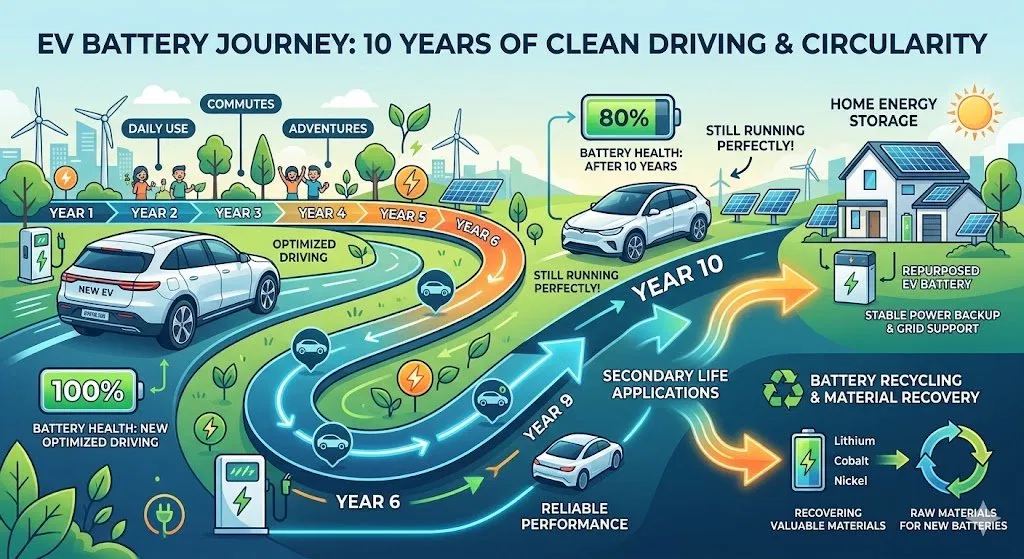
Recurrent Auto, a US company that analyses battery health data from hundreds of thousands of real-world EVs, publishes regular reports on degradation rates. Their data consistently shows that the average EV battery retains approximately 88% of its original capacity after 100,000 miles (160,000 km) — roughly 8–10 years of average driving.
A separate study from Tesla owners who have driven Model S and Model X vehicles for over 300,000 km — genuinely high-mileage use — shows average retention of around 80% at that extraordinary odometer reading. That's the worst-case end of the spectrum for real-world, high-mileage users.
How Batteries Actually Degrade
Battery degradation follows a characteristic curve: it's faster in the first year or two as the battery settles, then dramatically slows and becomes nearly linear at a low rate for years afterward. The initial fast degradation is often called the "break-in" phase — it's normal and expected, and doesn't continue at the same rate.
The main mechanisms of degradation are:
- Lithium plating: Lithium ions deposit as metal on the anode rather than inserting properly, reducing capacity and potentially causing short circuits. Charging at very low temperatures is the main culprit.
- SEI layer growth: A passivating layer forms on the anode over time, consuming lithium. It slows and mostly stops after the initial period — but contributes to that first-year capacity dip.
- Cathode degradation: High states of charge (consistently storing at 100%) and high temperatures stress the cathode material over time.
The three habits that maximise battery life: (1) Don't regularly charge to 100% unless you need the range that day — keep it at 80% for daily use on NMC. (2) Don't regularly sit at 0%. Charge before you hit 15–20%. (3) Avoid charging in very cold weather without pre-conditioning. LFP users can ignore the first rule entirely — LFP is designed for 100% daily charging.
Does This Mean the Car Becomes Useless?
Consider what 88% capacity means in practice. A new Tesla Model 3 Long Range has a WLTP range of around 600 km. At 88% capacity after 10 years, that's still approximately 528 km — more than enough for virtually any real-world journey. For the vast majority of owners who drive fewer than 50 km per day, the practical impact of 12% degradation is nearly invisible in daily life.
The "worthless battery" fear is largely inherited from early-generation smartphones and laptops, where battery degradation was genuinely severe. Modern EV batteries are engineered to a completely different standard — they have thermal management systems, sophisticated BMS protection, and they're designed for 10–15 year service lives, not 2–3 years.
What About Resale Value?
Battery health is becoming an increasingly transparent market signal. Multiple manufacturers now provide battery health reports that can be shared with potential buyers. In markets where EV adoption is highest — Norway, the Netherlands, the UK — used EVs with documented battery health sell for higher prices than comparable models without health data. The market is starting to price battery condition accurately.
The resale value concern is more real for early-generation EVs (2013–2017) with smaller batteries, where 30% degradation means going from 150 km to 105 km of range — a more meaningful impact. Modern EVs with 60+ kWh batteries have enough headroom that even significant degradation leaves the car functional and practical.
What Happens After the Battery Reaches End-of-Life?
An EV battery that has degraded past the point where it's useful in a vehicle — typically below 70–75% capacity — is not scrap. It enters a thriving second-life market as stationary energy storage. Batteries that are no longer suitable for the demands of vehicle acceleration and rapid charging work perfectly well for storing solar energy or acting as home backup power.
Beyond second life, battery recycling has become a serious industrial sector. Companies like Redwood Materials (founded by Tesla's former Chief Battery Officer) recover lithium, cobalt, nickel, and other materials from end-of-life batteries and feed them back into new cell production. The materials in your battery pack will likely end up in another EV battery rather than in landfill.
The one situation where degradation is faster than expected: Frequent use of 350 kW DC fast chargers at high states of charge, in hot climates, with no pre-conditioning. This combination stresses the battery significantly. Occasional rapid charging is fine — it's the daily habit of high-rate charging at high SoC and temperature that compounds degradation faster.
The Bottom Line
Your electric car is very unlikely to become worthless in 10 years. Real-world data from hundreds of thousands of vehicles shows that most batteries retain 85–92% of their capacity over a decade of typical use. The car doesn't become useless — it becomes a used car, just like any other, with well-documented battery health that increasingly transparent markets are learning to price correctly. The "battery doom" narrative is based on fears, not data.