Buying an electric car is one of the biggest financial decisions you'll make — and unlike a petrol car, the battery is the car. It determines your range, charging costs, long-term value, and daily experience. Manufacturer brochures don't tell you everything you need to know. We do.
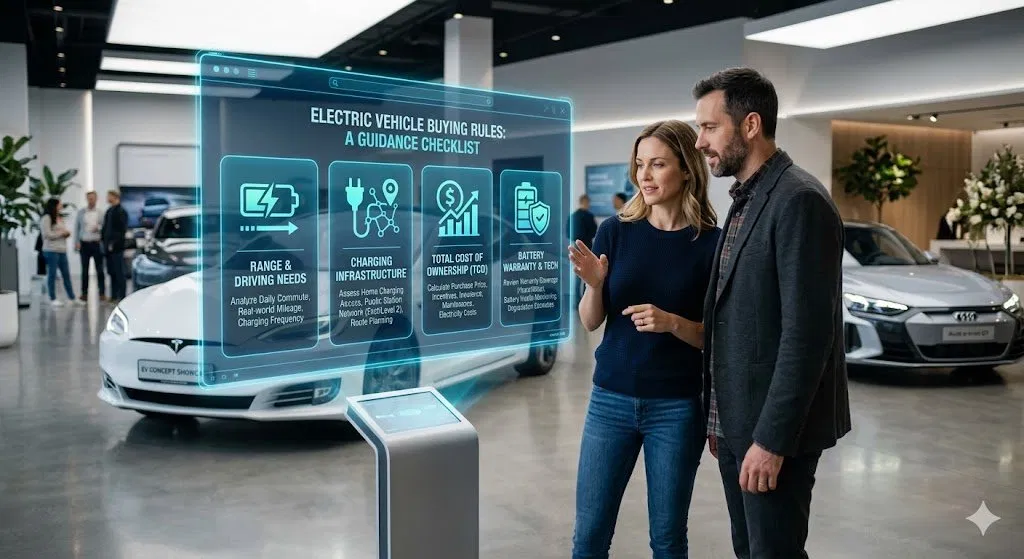
The 10 Rules
Know Your Battery Chemistry Before Anything Else
LFP batteries let you charge to 100% every day without stress and last 3,000+ cycles. NMC gives you more range per kilogram but prefers staying between 20–80%. NCA offers the highest energy density. The chemistry choice affects your entire ownership experience — not just range.
Ignore the WLTP Number — Focus on Real-World Range
WLTP is a lab test. Real-world range on the motorway at 130 km/h is typically 20–30% lower. Always check highway consumption figures, not just combined WLTP. Our database shows city and highway ranges separately — use them.
DC Charging Speed Matters More Than Battery Size
A 77 kWh battery that charges at 250 kW is more practical for long trips than a 100 kWh battery limited to 100 kW. The 10–90% charging time is the real number to compare — not peak kilowatts, which you'll rarely see in practice.
Check the Home Charging Situation First
If you live in a flat without dedicated parking, daily charging becomes a logistical problem. Public fast charging is expensive — typically 3–5x the cost of home charging. Make sure you have a realistic home charging plan before buying.
Battery Warranty Covers Degradation, Not Just Failure
Most manufacturers offer 8 years or 160,000 km with a guaranteed minimum capacity (usually 70%). Read the fine print — some warranties require dealer servicing to remain valid. LFP batteries typically outlast NMC on cycle count.
Key insight: The difference between a €30,000 EV and a €45,000 EV often comes down to battery chemistry, charging speed, and pack size — not the interior plastics. Focus your comparison on the battery specs.
Calculate Total Cost of Ownership, Not Just Purchase Price
EVs typically save €1,000–2,000 per year in fuel and maintenance costs over petrol cars. But purchase price is higher. Run the numbers over your expected ownership period — usually 5–7 years — before deciding.
800V Architecture Changes the Game for Long-Distance Drivers
Cars built on 800V platforms (Hyundai IONIQ 5/6, Kia EV6, Porsche Taycan, Mercedes CLA) charge significantly faster at high-power stations. If you drive long distances regularly, the charging speed difference between 400V and 800V is not trivial.
Cold Weather Reduces Range by 20–40%
All EV batteries perform worse in cold temperatures, but LFP is particularly affected. If you live in a cold climate, add a 30% buffer to your range calculations for winter. Heated parking and pre-conditioning features help significantly.
Check Software Update History
Unlike petrol cars, EVs improve over time through software updates. Tesla, Hyundai, and Rivian have track records of adding features and improving efficiency via OTA updates. Some brands still require dealer visits for every update.
Resale Value Follows Battery Health
When you sell the car, the buyer's first question will be about battery health. Cars with good charging habits (not habitually charged to 100% on NMC, not regularly DC fast-charged to 100%) retain value better. Start good habits from day one.
The One Thing Most Buyers Get Wrong
They compare brochure range numbers. The Peugeot e-3008 says 670 km, the Tesla Model Y says 600 km — so the Peugeot wins, right? Not necessarily. The Tesla charges at 250 kW vs the Peugeot's 160 kW. On a real 800 km journey, the Tesla might actually be faster door-to-door, despite the shorter nominal range. Always compare the full charging picture, not just the single number.
Watch out: Some manufacturers quote NEDC or CLTC range figures in markets where WLTP isn't mandatory. These can be 20–40% higher than real-world results. Always check which test cycle was used.
Quick Reference: Chemistry Comparison
| Property | LFP | NMC | NCA |
|---|---|---|---|
| Charge to 100% | Every day ✓ | 20–80% preferred | 20–80% preferred |
| Cycle life | 3,000+ cycles | 1,000–2,000 | 800–1,500 |
| Energy density | Lower | High | Highest |
| Cold weather | Most affected | Good | Good |