Every time an electric car catches fire, it makes international headlines. A petrol car fire — statistically far more common — barely registers as local news. This asymmetry has created a deeply distorted picture of EV safety in the public mind. Let's look at what the data actually says.
The Numbers: EVs vs Petrol Cars
According to data from the Swedish Civil Contingencies Agency and various European fire services, electric vehicles catch fire at a rate of approximately 0.0012% per vehicle per year. Petrol and diesel vehicles catch fire at a rate roughly 80 times higher. Hybrid vehicles — carrying both a fuel tank and a battery — have the highest fire rate of all three categories.
The perception problem is driven by two factors: EV fires are genuinely harder to extinguish (they can reignite hours after being put out), and they're new and novel, so they attract media attention. But raw frequency? EVs are dramatically safer from a fire risk perspective.
In plain numbers: For every EV fire, there are approximately 80 petrol car fires. You are statistically far more likely to have a fire incident in a conventional vehicle than an electric one.
What Is Thermal Runaway?
The specific risk in EV batteries is called thermal runaway — a chain reaction where one cell overheats, causes neighbouring cells to overheat, and the process accelerates. In the worst case, this produces intense heat and toxic gases. It's the mechanism behind most serious EV battery fires.
What triggers thermal runaway? The three main causes are:
- Physical damage: A severe collision that punctures the battery pack
- Overcharging: Charging beyond the maximum safe voltage, usually due to faulty charging equipment
- Manufacturing defect: A rare internal short circuit within individual cells
Normal use — charging to 100%, driving hard, parking in the sun — does not cause thermal runaway. Modern Battery Management Systems (BMS) prevent overcharging entirely. The thermal runaway events you read about are almost always caused by crashes or manufacturing defects, not ordinary use.
How Modern Safety Systems Prevent It
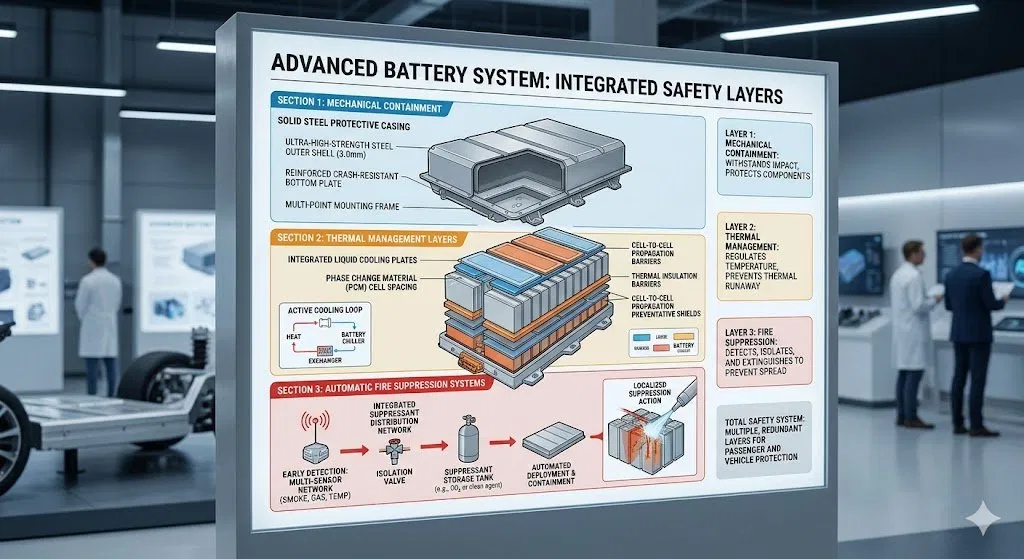
Every modern EV battery pack is engineered with multiple layers of protection that didn't exist in earlier electric vehicles:
Layer 1 — Mechanical containment: Battery packs sit inside reinforced steel or aluminium housings with crash-resistant bottom plates. The pack is designed to absorb impact before cells are damaged.
Layer 2 — Thermal management: Active liquid cooling systems maintain cells at optimal temperatures and prevent any single cell from becoming a hot spot. Cell-to-cell insulation barriers physically slow any thermal spread.
Layer 3 — Battery Management System: The BMS monitors every individual cell's voltage, temperature, and state of charge in real time. It cuts charging power if any cell approaches unsafe conditions. It's why you genuinely cannot overcharge a modern EV — the car simply stops accepting current.
Which Battery Chemistry Is Safest?
LFP (Lithium Iron Phosphate) is the clear winner on safety. Its chemistry is inherently more thermally stable than NMC or NCA. LFP cells do not produce oxygen during thermal runaway, which dramatically reduces fire intensity even in worst-case scenarios. BYD's Blade Battery architecture, which integrates cells directly into structural components, has passed nail penetration tests that destroy NMC cells — a test the industry had previously considered impossible.
NMC is more energy-dense and therefore more common in longer-range vehicles, but it requires more careful thermal management. Well-engineered NMC packs are still very safe in normal use. The risk difference between LFP and NMC matters most in extreme crash scenarios.
The real risk factor: The biggest cause of EV fires in practice is flood damage. Saltwater corrosion of battery cells causes internal short circuits. If your EV has been submerged, have it professionally inspected before charging — do not assume it's fine because it turns on.
What About Explosions?
Electric car batteries do not explode in the cinematic sense. There is no detonation. What can happen in a severe thermal runaway event is the rapid release of flammable gases, which can ignite. This looks dramatic on video — but it's a venting fire, not an explosion. Modern pack design includes venting channels that direct gases away from the passenger compartment.
The real firefighting challenge with EV fires is that cells can reignite hours or even days after the initial fire is out, because internal cells may still be reacting. Fire services have developed specific protocols — often involving large volumes of water or purpose-built thermal blankets — to manage this. The vehicles are genuinely harder to fully extinguish, even if they're significantly less likely to catch fire in the first place.
The Bottom Line
Electric cars are not more dangerous than petrol cars. The data is clear, the fire statistics are in their favour, and every year battery chemistry and pack engineering improve further. The media coverage creates a distorted impression because EV fires are unusual and visually striking. A rational risk assessment points clearly in one direction: EVs are safer, not more dangerous.
If you're choosing between LFP and NMC for safety reasons specifically — choose LFP. But both are engineered to a level of safety that would have seemed remarkable even 15 years ago.