If you've ever stepped into an electric car for the first time and floored the accelerator, you know the feeling — an immediate, seamless surge of acceleration that doesn't build up like a petrol engine but arrives all at once. That sensation has a precise physical explanation, and it changes everything about how these machines work.
The Fundamental Difference: How Torque Is Generated
In a petrol engine, torque is produced by combustion pressure acting on pistons. The catch is that combustion requires the engine to be spinning — there's an optimal RPM range where the combustion timing, intake flow, and exhaust scavenging all work together efficiently. Below that range, the engine feels sluggish. Above it, power starts to fall off. That's why a petrol car's power band exists.
An electric motor works on completely different physics. A permanent magnet synchronous motor — the type used in most modern EVs — generates torque through electromagnetic force between the stator's magnetic field and the rotor's permanent magnets. Crucially, this force is maximum when the rotor is stationary. The moment you apply current, full torque is available. Instantly. At zero RPM.
The Torque Curve: Flat vs Peaked
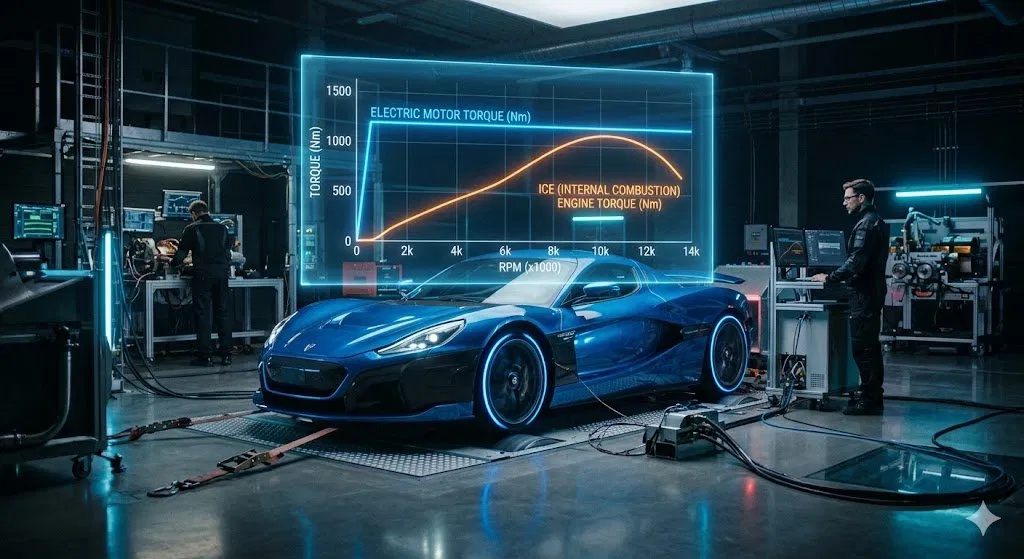
If you plot torque against RPM for both motor types, the difference is dramatic. A petrol engine produces a hill-shaped curve: torque rises as RPM increases, peaks somewhere in the middle of the rev range, then falls off. This is why performance petrol cars need complex multi-speed gearboxes — to keep the engine operating near its peak torque band at different road speeds.
An electric motor produces a nearly flat torque curve from zero RPM up to a transition point called the base speed. Beyond base speed, the motor enters a "field weakening" region where torque decreases but power remains roughly constant. The practical result: maximum torque is always available when you need it most — at low speeds, when pulling away, when overtaking.
Why EVs Don't Need a Multi-Speed Gearbox
Because the torque curve is flat and power stays relatively constant across a wide RPM range, a single fixed gear ratio covers both city driving and motorway speeds without any compromise. This eliminates the gearbox entirely — or reduces it to a single-speed reduction drive. The result is mechanical simplicity: fewer moving parts, lower maintenance, and that completely smooth, seamless acceleration feel with no gear shift interruptions.
Some high-performance EVs are starting to use two-speed gearboxes — the new Mercedes CLA uses one on the rear axle — to push efficiency at motorway speeds even higher. But this is an efficiency optimisation, not a necessity.
Why the 0–100 km/h time is misleading for EVs: An EV with a 4-second 0–100 time feels faster from 0–50 km/h than a petrol car with the same claimed time, because the EV's torque is fully available immediately. The petrol car needs to rev up and change gears to build to its peak power. In real-world driving, the EV pulls harder in the situations that actually matter.
Traction: The Limiting Factor
The irony of instant torque is that the tyres are usually the limitation, not the motor. Apply too much torque to a small contact patch — especially on a wet surface — and the wheels spin. This is why modern EVs rely heavily on traction control software that modulates motor output dozens of times per second to keep each wheel at the edge of grip without crossing it.
Dual-motor AWD EVs have a significant advantage here: they can distribute torque independently between front and rear axles in milliseconds, balancing traction in ways that are physically impossible with a conventional mechanical differential. This is why a dual-motor EV often feels more planted and controllable at its limit than a more powerful single-motor version.
Regenerative Braking: Torque in Reverse
The same motor that propels the car can run in reverse as a generator, using the car's kinetic energy to charge the battery when slowing down. This is regenerative braking. It recaptures 10–25% of energy that would otherwise be lost as heat in conventional brakes, extending real-world range significantly.
The strength of regen can usually be adjusted by the driver — from gentle coasting feel to aggressive one-pedal driving where releasing the accelerator brings the car nearly to a stop. Many EV drivers report that once adapted to one-pedal driving, returning to a conventional car feels strange.
The Bottom Line
Electric motors deliver maximum torque from the moment the car begins to move. There's no revving, no waiting for a power band, no gear changes — just immediate, linear force. Combined with the precision of electronic torque control and the advantages of AWD torque vectoring, this produces a driving character that feels fundamentally different from anything a combustion engine can replicate. It's not just that EVs are fast. It's that they're fast in a completely different way.